

Pride cometh before the fall: the sporting backlash
Pride in Sport is doing more harm than good

It is time to end Pride in sport. Some find it odd that I argue this given I am myself gay, but I am of the view that these initiatives are doing more harm than good. Pride campaigns in professional sport keep exploding into controversy because, while I am sure mostly are good intentioned, they have stopped being about tolerance and are now about compelled performance.
The point of activism was for gay people to be treated fairly, but this has been hijacked by the identitarians who keep adding letters after “LGB” and now demand that other people publicly affirm political and moral messages they may not personally hold. Then, when athletes refuse or pushback, everyone acts shocked that the result is resentment rather than harmony. I find the whole thing pretty cringeworthy and tedious. I do not need my sexuality stitched onto somebody else’s jersey. Rainbows on a baseball cap, a rugby league strip, or a FIFA matchday activation do not validate my existence. I just want to be treated fairly and not discriminated against. The ideal situation as I see it, is if we simply agree to leave each other alone. Religious people tolerate the gays and gays tolerate the religious.
Ironically, Pride campaigns are producing exactly the opposite of what they claim to want. We were getting to the point that most people simply didn’t care if you were gay and that is how we were able to make so many gains in advancing our rights. Increasingly, however, gay identity has become associated with compulsory workplace seminars, rainbow branding, ideological tests, and public virtue signalling. Activists are continually mistaking visibility for acceptance. The more people associate homosexuality with being endlessly lectured, the more goodwill they burn through. And many of them don’t have skin in the game, so to speak. I do.
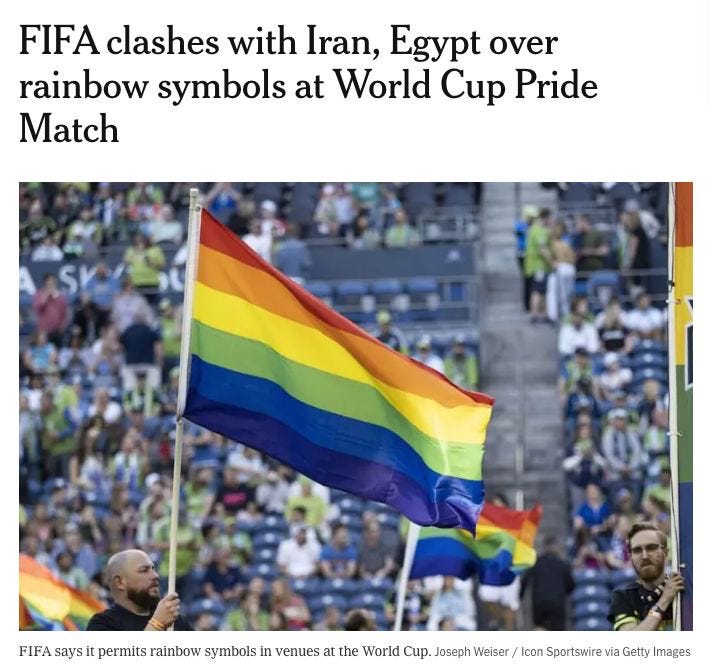
FIFA’s so-called Pride Match in Seattle this week is almost too ridiculous to be true. Luck would have it that the match between Iran and Egypt has fallen on the location and time set for the Pride match. The minute administrators saw this, they should have pulled the pin on the Pride plans. Iran and Egypt are not mildly socially conservative countries where a few fans back home will feel uncomfortable about rainbow flags. They are countries where homosexuality is criminalised, suppressed, and treated as a threat to public morality. Iran still executes gays. Egypt has arrested and prosecuted gay people under morality and indecency laws, and has cracked down on visible expressions of Pride. Both countries are places where being visibly gay could get you killed by your family or community never mind the state. Yet woke idiots in corporate offices somewhere have decided that by the magic of Western event branding these countries will now take part in a Pride-themed football spectacle in Seattle.
Utterly ludicrous. If Pride is supposed to stand against genuine persecution, then what exactly is achieved by turning an Iran vs Egypt match into a rainbow-branded occasion while the regimes themselves do nothing except use the opportunity to announce how angry they are and how much they do not tolerate homosexuality.
Both football federations have formally objected to Seattle designating the fixture as a "Pride Match" because it conflicts with their countries' cultural, religious and legal positions on homosexuality. Iran reportedly asked FIFA to prevent Pride branding and related activities within the stadium, while Egypt also sent a formal protest rejecting any association between the match and LGBTQ messaging. FIFA has rejected the requests saying the Seattle Pride celebrations are a local organising committee initiative rather than an official FIFA event, but it will still permit rainbow flags and Pride symbols inside the stadium under its inclusion policies. The game is set to take place Saturday 27th June at 3pm NZ time.
The same tensions between religious beliefs and Pride play out across professional sport. However, unlike despotic regimes, it is much easier to pressure athletes in liberal democracies who may have objections to being used as human advertising for Pride. Administrators for professional sport have seemingly decided en masse that rugby league players, baseball players, footballers, and clubs are expected to take part in Pride campaigns they may not personally endorse or feel comfortable with. The issue is there is a bit of a self-fulfiling prophecy to it as when athletes push back, the story becomes that this is proof that Pride is “needed”. But the drama and confrontation is entirely unnecessary and constructed by those who should reasonably be able to foresee the tensions that will be created. They deliberately provoke predictable resistance, then point to the resistance as evidence that the confrontation was necessary all along.
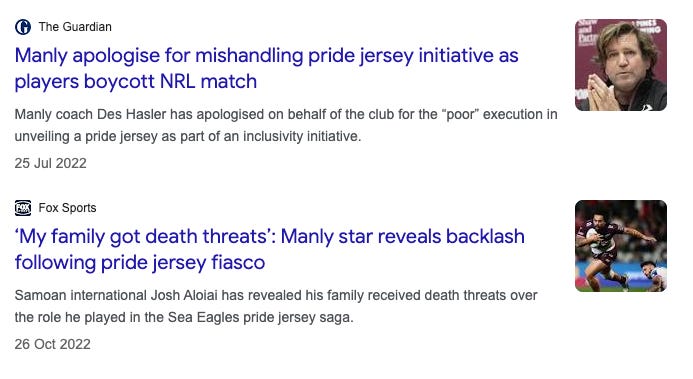
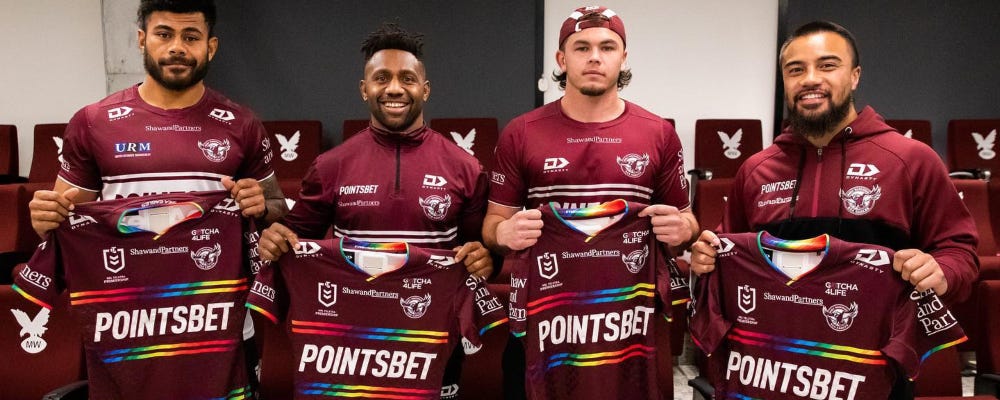
The Manly Sea Eagles Pride jersey controversy in 2022 was an example of this. Seven players were stood down from a match after being told to wear a jersey celebrating Pride. The group of players were all Pacific Islanders and their objections were both religious and cultural. Coach Des Hasler, to his credit, did not pretend this was simply a case of nasty bigots refusing to be nice. He acknowledged that the club had failed to consult with players properly and that the execution of the initiative had been poor. It was imposed on them with no discussion, much like what is being done on a wider level with council and even national Pride events. If you are going to require athletes to wear a political or moral symbol on their bodies, you had better understand that they may see that as more than a marketing exercise. Instead, administrators seem to have learned nothing beyond “next time, apply more pressure on the bigots”.
The more recent York Revolution baseball case is even more ridiculous as it all ended in tears. The team was meant to play its Pride Night game wearing uniforms with rainbow sleeves, but several players refused. Rather than simply allowing those players to wear standard kit or finding a compromise, the club forfeited the entire game.
The pro-Pride reaction was “oh my god, they cancelled a sporting match because grown adults couldn’t bring themselves to wear rainbow colours” and on the other side it was “good grief, they’ve cancelled a sporting match because they couldn’t handle athletes saying ‘no’ to being politicised”. Either way, an actual sporting fixture was sacrificed because of the clash between Pride and sport.
The club president said he had asked for tolerance and the players were unwilling to navigate that. But in defence of the players, they were not being asked to be tolerant, they were being forced to participate. Tolerance means people with different beliefs can coexist and effectively leave each other alone. It does not mean one side gets to design a costume and require the other side to wear it.
The San Francisco Giants controversy followed the same script, just with a battle of moral marketing. Several Giants pitchers received warnings after they wrote Bible verses on their Pride Night caps. Major League Baseball said the warning was not about the content of the message but about uniform rules prohibiting writing on apparel. That may be technically true, but it is also laughable. A Pride cap is treated as inclusion and a Bible verse on that Pride cap is treated as a provocation.
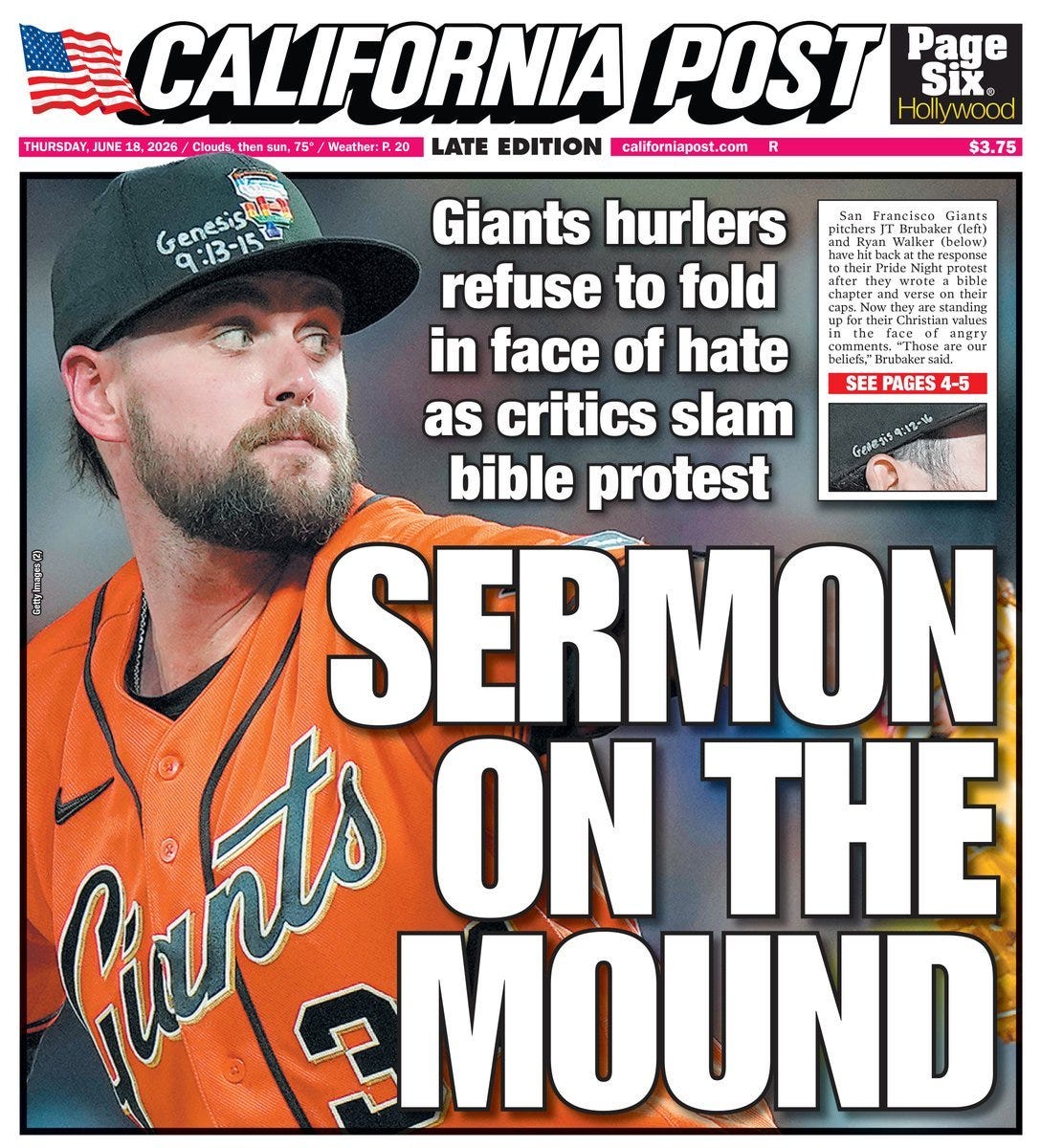
The media flurry surrounding the drama has illuminated what a farce this all is. Gay people are not feeling more included and accepted and the athletes are feeling harassed. It is setting up conflicts and binaries that are very unhelpful. The United States Department of Justice later questioned whether MLB was applying its rules consistently, pointing to previous examples of permitted social justice messaging including Black Lives Matter symbolism.
In New Zealand and Australia, it is my observation that athletes tend to be more religious than the general population. Sports like rugby and rugby league in particular have a lot of Pasifika players who are devout Christians. In America where the population is more religious, athletes at least match the religiosity. So it is no wonder that the issue that keeps cropping up is that sport keeps creating situations where athletes are pressured to choose between their faith and their job.
Israel Folau remains the defining case for this because his experience exposed the unresolved conflict at the heart of it all. Folau posted on Instagram a blunt biblical warning that included homosexuals among a list of sinners headed for hell unless they repent. Now I do not really care if Folau thinks that hell awaits me. I am much more concerned about the religious people who see throwing us off buildings as an appropriate remedy for homosexuality. But I understand that it is upsetting for some gay people to be condemned like this. It is not very nice, we could say.
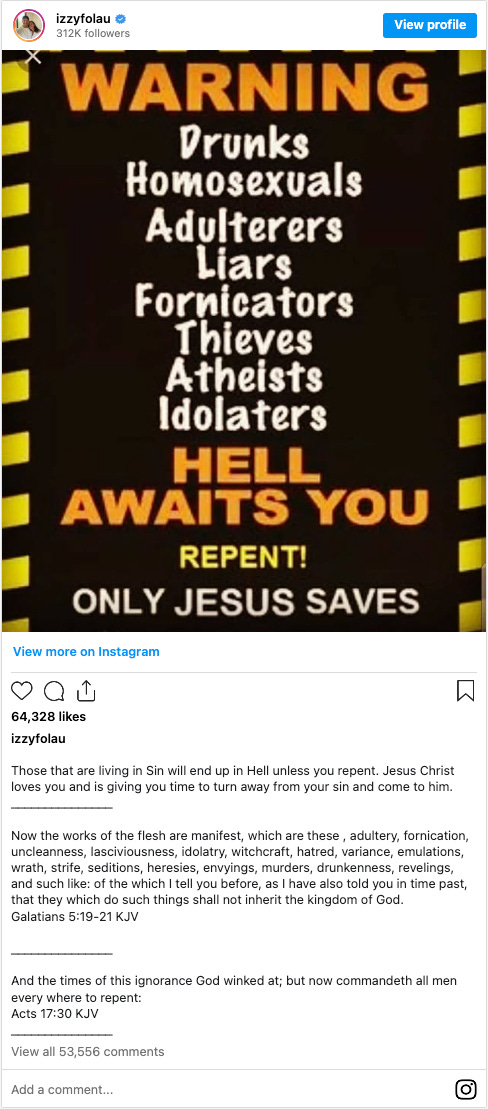
However, disliking what someone says is not the same as believing they should be professionally destroyed forever. Folau lost his Rugby Australia contract in 2019 because he refused to apologise for the Instagram post, and while he later reached a monetary settlement, years later he remains effectively radioactive in Australian professional sport. His wife, former Silver Fern, Maria Folau has claimed his recent attempted return to the NRL through the Wests Tigers collapsed because of concerns about “inclusiveness” and because it would be a “bad look”. Folau himself has argued that there is a double standard, asking why players guilty of actual criminal offences have been allowed back while his Christian beliefs make him unacceptable.
The uncomfortable truth is that disproportionate responses like this are completely irrational. Even if one dislikes what Folau says, professional sport has tolerated players who have committed real world harmful crimes and yet certain beliefs, especially traditional Christian beliefs about homosexuality, are somehow worse. This does not persuade religious communities to become more tolerant of gay people. It convinces them that “inclusion” is a weapon used selectively to persecute them. That is not good for gay people. Nor for religious people. And it turns people off sport.
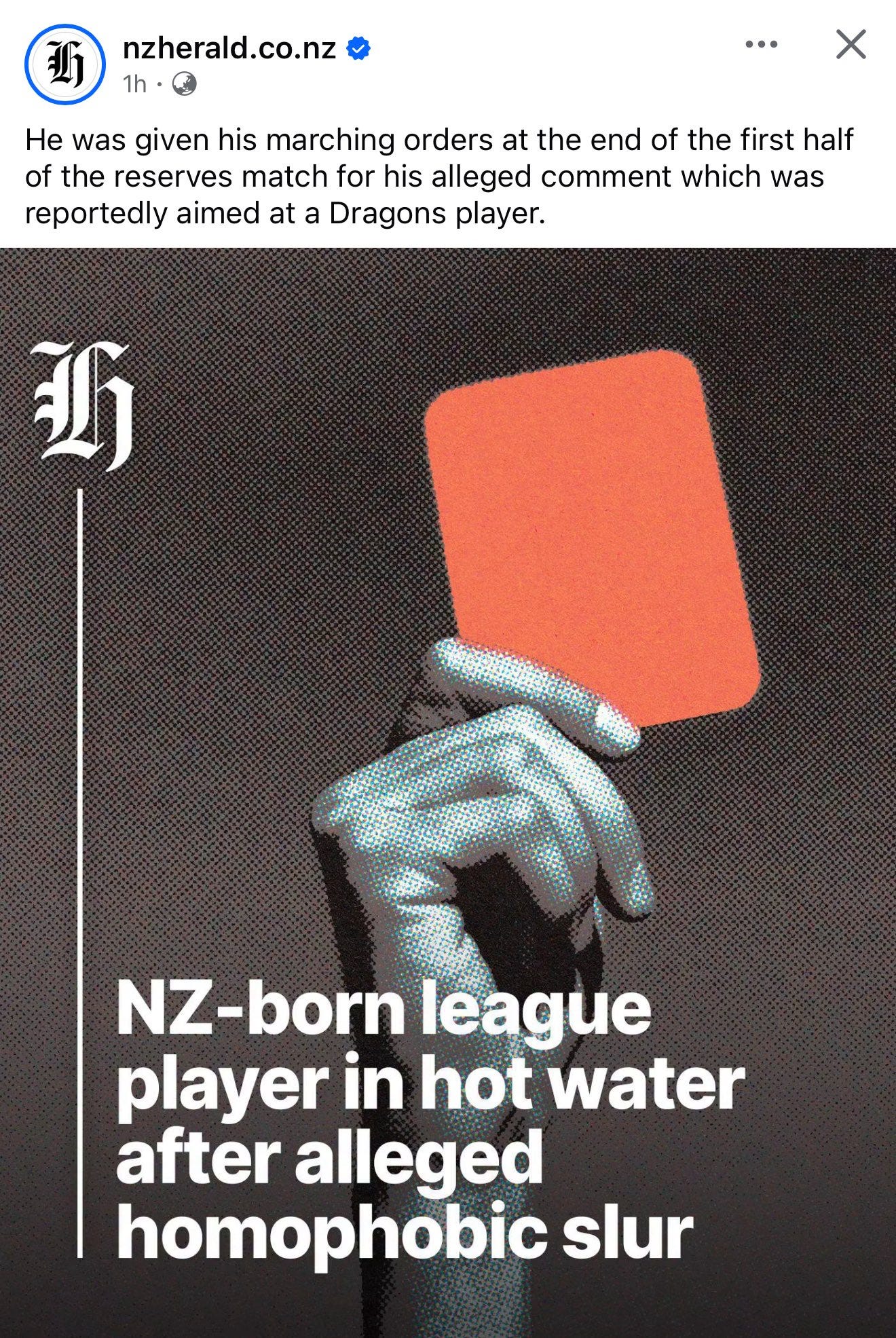
None of this means actual homophobic abuse should be ignored. The recent Asu Kepaoa case is different in that codes of conduct police abusive behaviour of any kind. However, I do again raise the question of proportionality regarding the length of the ban he received. Kepaoa received a six match ban after pleading guilty to using a homophobic slur during a reserve-grade match. It is perfectly reasonable for sporting codes to punish targeted abuse of another player during competition. And there is a considerable difference between enforcing standards of conduct on the field and requiring players to wear symbolic endorsements off it or espouse particular beliefs.
What fascinates me is that Pride activists never seem to stop and wonder why the same controversy keeps happening in completely different sports across the Western world. Different athletes, different religions, different administrators. The same dramas. The common denominator is not an epidemic of homophobia. It is administrators repeatedly insisting that professional athletes become unwilling participants in political campaigns.
My argument is that the aim of any advocacy for gay acceptance should be normality, not endless identity performance. I want gay athletes and fans to be able to participate in sport without fear, abuse, or discrimination. I do not want every match to become a referendum on whether everyone in the stadium affirms my private life. I am deeply uncomfortable about the way modern activism keeps dragging sexuality into spaces where it does not need to be and where no one else is being sexual. If heterosexuals were holding signs and waving flags about how great it is to be straight at sporting matches there might be an argument for us to be allowed to join in with our rainbows. But sport is not a forum focused on sexuality and so it is odd that some people want to drag our sexuality into it. We spent decades arguing that gay people are normal, only to arrive at a point where our supposed allies insist on making everything about being gay all the time.
Sport is one of the few remaining places where people who disagree about almost everything can still share something. A conservative Christian, a gay atheist, a Muslim migrant, a progressive student, and a grumpy old bloke who hates everyone equally can all sit in the same stadium and cheer for the same team. That is pretty cool when you think about. But that kind of coming together is under threat the more sporting bodies turn games into compulsory political sermons, the more they erode the common ground that makes sport special in the first place.
There is a place for Pride. In my view one day a year is plenty. Let’s have the parade, wave the flags, and those who want to celebrate can celebrate. But we have to stop the colonising of every institution, every workplace, every sports league and every uniform on our behalf. Reluctance to participate in corporate rainbow rituals is not the same as hatred and I absolutely back up any athlete who says “no” to having Pride foisted on them. I would really like people to stop making gays the symbolic burden everyone else is expected to carry. It is not making people more accepting. It is making them annoyed, resentful, and suspicious of the very communities these campaigns claim to support. It is making things worse.
The stupidest thing is that actual equality is a far better and more popular proposition than this endless identity crap. Most people are perfectly capable of treating gay people decently and do not want discrimination. Most people are tolerant, but they don’t want to feel they are being lectured, coerced, or forced to participate in messaging like some kind of humiliation ritual. Pride activists need to realise that tolerance is not produced by compulsion, it requires simple coexistence, and the more they demand public affirmation, the more they sabotage the normality gay people fought so hard to achieve.
I do not need a rainbow jersey to know I belong at the game. I want the game to be a place where people can enjoy being entertained and forget all of the tensions and politics that plague our normal lives. Sport is meant to be an escape. All that matters is whether our team gets the ball over the line or into the back of the net. Not if we go to church or not, belong to a trade union or work for a big corporate, or are male, female, young, old, black, white, left, right, gay, or straight. Erasing our differences rather than highlighting them would do more for genuine inclusion than any amount of performative branding ever will.
I never understood the Israel Falau controversy
When you look at his list it includes at over half of the population
Why did the gays feel it was aimed at them?
That was a beautifully written article Ani, couldn’t agree more.
The ongoing Folau saga is pathetic. After his first post, he was baited by some activist into saying something similar, which was the ultimate reason he lost his contract.
I’m a straight atheist, and did not find being threatened with banishment to a place that doesn’t exist to be even vaguely concerning. I can’t imagine for a moment that any gay person would feel differently.
They simply wanted him cancelled for wrongthink, and got their wish - at the same time winning Folau a huge new following, including me.